


Fully Welded Full Bore Ball Valve Q61F-16C
A fully welded, full-bore ball valve spanning DN10 to DN200 at PN16. Forged-and-welded body with zero bolts and zero gaskets — continuous steel from butt-weld end to butt-weld end. Ball bore equals pipe ID. Shouldered stem, captive from inside. Quarter-turn lever. Soft-seated options (PTFE, PPL, PEEK) and metal-seated options are available. The available series covers -29°C to +350°C, depending on seat material and valve configuration. Bi-directional, no flow arrow. Built for district heating, gas distribution, geothermal, and buried cooling water branch lines.
- Nominal Pressure: 1.6 MPa (PN16)
- Series Pressure Options: PN16–PN160 (configuration-dependent)
- Strength Test: 2.4 MPa
- Sealing Test (Water, PN16): 1.76 MPa
- Air Sealing Test (PN16): 0.6 MPa
- Available Temperature Range: -29°C to +350°C (configuration-dependent)
- Applicable Medium:Water, Gas, Oil products, etc.
Technical Specifications
Technical Requirement
| Design & Manufacture | Face-to-Face Length | Welding Standard | Inspection Standard |
|---|---|---|---|
| GB/T19672 | Manufacturer Standard | GB/T12224 | GB/T13927 |
Performance Specifications
| Nominal Pressure | Strength Test | Sealing Test (Water) | Air Sealing Test | Applicable Temperature | Applicable Medium |
|---|---|---|---|---|---|
| 1.6MPa | 2.4MPa | 1.76MPa | 0.6MPa | -29~+350℃ (depending on seat and valve configuration) | Water, Gas, Oil products, etc. |
Seat options include soft seats (PTFE, PPL, PEEK) and metal seats. Temperature limits vary with seat material and valve configuration; +350°C does not apply to every configuration.
Pressure Test Data (Available Series)
The Q61F-16C model shown here is PN16. PN25–PN160 pressure classes refer to available series configurations, subject to model and material selection.
| Pressure Rating | Shell Test (MPa) | Sealing Test (MPa) | Air Sealing Test (MPa) |
|---|---|---|---|
| PN16 | 2.4 | 1.76 | 0.6 |
| PN25 | 3.75 | 2.75 | 0.6 |
| PN40 | 6.0 | 4.4 | 0.6 |
| PN63 | 9.45 | 6.93 | 0.6 |
| PN100 | 15.0 | 11.0 | 0.6 |
| PN160 | 24.0 | 17.6 | 0.6 |
Material of Components
| No. | Component Name | Material | No. | Component Name | Material |
|---|---|---|---|---|---|
| 16 | Handle | A276-410 | 8 | Stem Gasket | PTFE+C |
| 15 | Cross Pin | A193-B7 | 7 | Ball | SS201 |
| 14 | Packing Gland | A276-410 | 6 | Inner Body | 20# |
| 13 | O-Ring | VOTIN | 5 | Valve Seat | PTFE+C |
| 12 | Sealing Gasket | PTFE+C | 4 | O-Ring | VOTIN |
| 11 | Stem Sleeve | 20# | 3 | Fireproof Ring | A276-410 |
| 10 | Valve Stem | 2Cr13 | 2 | Disc Spring | 60Si2Mn |
| 9 | Composite Sleeve | PTFE+SPCC | 1 | Connecting Pipe | 20# |
Main Shape Size and Connection Size
| DN | L | D | A | B | L1 | H | H1 | Dmin | Mass (kg) | Kv.m³/Y |
|---|---|---|---|---|---|---|---|---|---|---|
| 10 | 130 | 17 | 27 | 220 | 155 | 113 | 158 | 11.4 | 1.8 | 6 |
| 15 | 130 | 21.3 | 34 | 220 | 155 | 113 | 161 | 12.5 | 2.1 | 16.3 |
| 20 | 150 | 26.8 | 42 | 230 | 155 | 116 | 169 | 17 | 2.8 | 29.5 |
| 25 | 160 | 33.5 | 48 | 235 | 155 | 120 | 178 | 24 | 3.7 | 43 |
| 32 | 180 | 42.3 | 57 | 337 | 247 | 150 | 218 | 30 | 5.1 | 89 |
| 40 | 200 | 51 | 76 | 347 | 247 | 155 | 228 | 37 | 5.9 | 230 |
| 50 | 230 | 60 | 89 | 362 | 247 | 147 | 227 | 48 | 7.9 | 265 |
| 65 | 290 | 76 | 108 | 458 | 313 | 170 | 260 | 64 | 10.6 | 540 |
| 80 | 310 | 89 | 133 | 468 | 313 | 178 | 276 | 75 | 12.7 | 873 |
| 100 | 350 | 108 | 159 | 843 | 668 | 170 | 285 | 98 | 22.8 | 1390 |
| 125 | 400 | 133 | 180 | 868 | 668 | 188 | 320 | 123 | 32.3 | 1707 |
| 150 | 480 | 159 | 219 | 908 | 668 | 216 | 368 | 148 | 44.2 | 2024 |
| 200 | 600 | 219 | 273 | 1103 | 803 | 271 | 464 | 195 | 85.4 | 2720 |
Technical Drawings
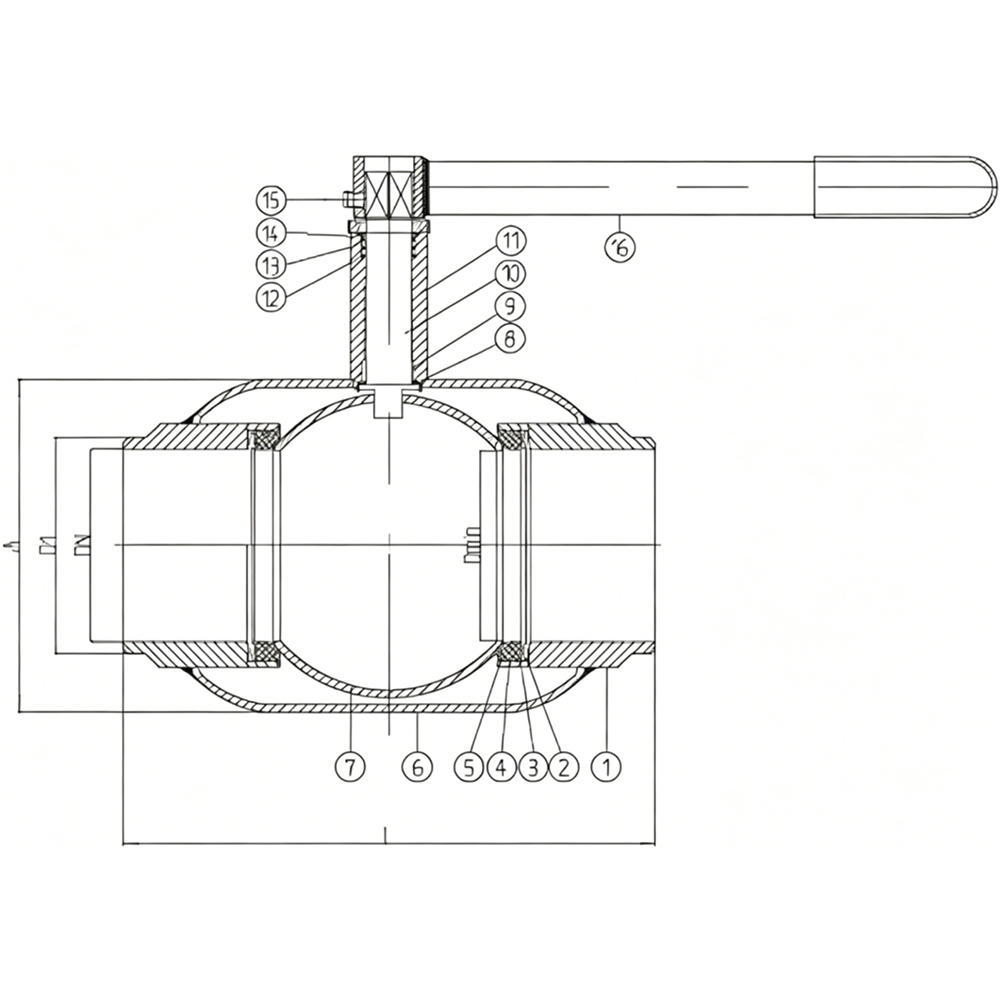
Core Features & Advantages
1. Butt-Weld, Zero-Leak Body Beveled to ASME B16.25, each side accepts a full-penetration weld that turns valve and pipe into one continuous piece — no gaskets, no bolt circle, nothing to loosen. No bolted flanges means the body spans only what the ball and seats require, roughly 40% shorter face-to-face than a flanged equivalent.
2. Full Bore Ball bore equals pipe ID. From inlet weld to outlet weld, the flow path is a straight cylinder — zero reduction, zero turbulence, zero energy penalty.
3. Direct Lever, Anti-Blowout Stem 90° throw with no gearbox — handle position is the only position indicator needed, readable from across the valve pit. The stem shoulder is larger than the packing bore below it, so line pressure only seats it tighter; mechanically captive whether the handle is attached or not.
4. Lightweight One-Piece Construction No bolt-load thickenings, no flange rings — a uniformly stressed cylindrical pressure vessel that carries PN16 without the dead weight. Less steel on the truck, less tonnage on the lift plan.
5. Low-Temperature Qualified, Zero Body Maintenance Forging and weld procedure rated for sub-zero service — no bolts to lose preload, no gaskets to stiffen below -20°C. Ball and seats swap from the top without cutting the valve out; the body has no recurring service entry on the maintenance log.
Applications
- District Heating Primary and Secondary Networks
- Natural Gas Distribution Below Ground
- Geothermal Energy Transfer Loops
- LNG Vaporizer and Boil-Off Gas Skids
- Remote Water Transmission Pipelines
- Biogas and Landfill Gas Collection
- Solar Thermal and Concentrated Solar Power Heat Transfer
- Buried Cooling Water Networks for Data Centers
- Underground Fire Water Ring Mains
- Cryogenic Nitrogen and Oxygen Distribution
Why Choose Fully Welded Full Bore Ball Valve Q61F-16C?
1. Weld-End, No Hidden Leak Points Butt-weld ends beveled to ASME B16.25 — same full-penetration procedure your crew runs on every joint. One weld, one inspection, and the valve-to-pipe interface is stronger than the parent metal. Body-to-pipe welds sit on the outside where RT or UT verifies them before backfill; the only dynamic seal is stem packing, accessible from above grade.
2. Thermal-Proof, Stem Captive A single homogeneous steel cylinder expands and contracts uniformly with the connected pipe — no interfaces to accumulate micro-displacement, no bolt torque to log. The stem shoulder is larger than the bore below it, so line pressure only seats it tighter; captive whether the handle is on or off.
3. 40% Lighter Than Flanged Equivalents No bolt-load thickenings, no flange rings — less steel on the truck, more valves per container, smaller excavation footprint on site.
4. One Platform, DN10–DN200 Same seat material, same stem seal, same weld prep, same torque values across the entire range. Stock one set of seat rings and stem seals, and every valve on site is covered.
Why Q61F-16C in One Sentence A butt-weld full-bore ball valve that becomes part of the pipe — lighter to ship, immune to thermal ratcheting, and built to hold pressure longer than the pipeline’s next three generations of bolted-body isolation valves.


